
Free Case Study: "How a 130-Branch Auto Parts Distributor Cut Freight Costs 22% With Automated Tendering"
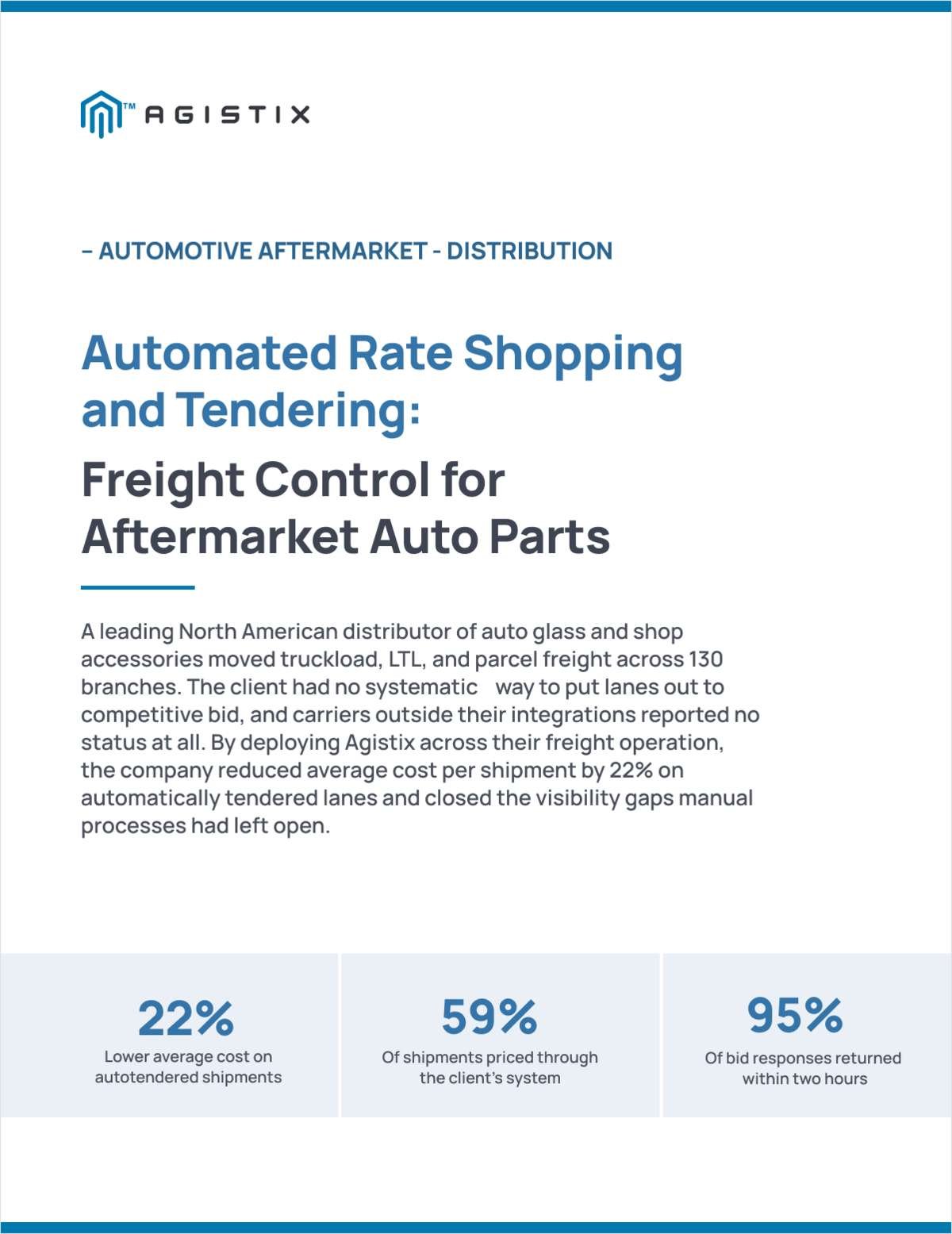
Across 130 branches, freight cost control came down to how much time the team could spend chasing rates. See how an $845M automotive aftermarket distributor replaced manual rate shopping with automated bidding and tendering, cutting per-shipment costs 22% and closing visibility gaps.
For a distributor booking freight across 130 branches in the U.S. and Canada, every shipment was a cost decision made by hand — rates checked one carrier at a time, with no systematic way to put high-volume lanes out to competitive bid.
This case study details how a leading aftermarket auto parts distributor moved past manual rate shopping and fragmented carrier visibility to run freight on defined rules that apply to every shipment, no matter which branch books it.
Inside, you’ll find:
The four operational gaps that slowed down bookings and hid cost-savings opportunities
How integrated rate shopping unified the client’s internal rating system with live carrier rates at the point of booking
The numbers behind it: 22% lower average cost per shipment on automatically tendered lanes, 95% of bid responses returned within two hours, and 64% of tenders awarded without manual carrier selection
How self-serve microsites and QR-code POD scanning brought non-integrated carriers into the visibility loop without EDI or API connections
If your logistics team is still rate-shopping manually, chasing carrier status updates, or missing consolidation opportunities buried in disconnected systems, this case study is for you.
Download now to see how automated tendering turns freight spend into a controllable, rules-driven process.
FILL THE FORM BELOW
© An Imprint of coreinteltech | All rights reserved | Privacy Policy